
Guantánamo Background
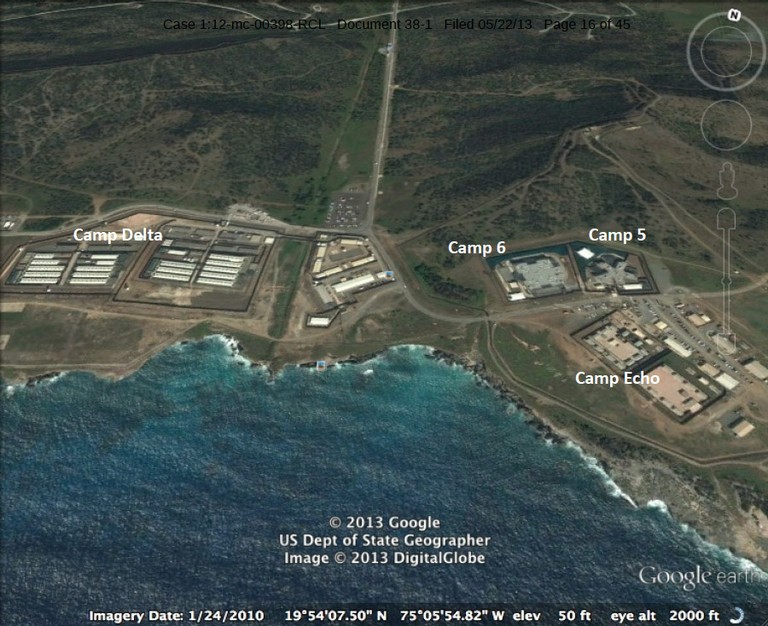 Source: Declaration of David H. Remes in support of emergency motion concerning access to counsel. 05/22/13. Civ. No. 05-1429 (RCL)
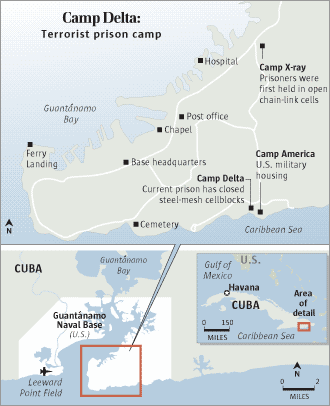
Map Credit: Seattle Times
The Guantánamo Naval Base: A Chronology of Events
|
June 10, 1898 |
A U.S. Marine Corps battalion -- the first U.S. troops to land on Cuba during the Spanish-American War -- camps at Guantanamo Bay. |
|
February 23, 1903 |
U.S. President Theodore Roosevelt signs a deal with the new government of Cuba to lease 45 square miles at the mouth of Guantanamo Bay for 2,000 gold coins a year -- now valued at $4,085. The U.S. government continues to pay the lease every year, but Fidel Castro's government refuses to cash the checks. |
|
1934 |
The United States and Cuba renegotiate the Guantanamo Bay lease, agreeing that the land would revert to Cuban control only if abandoned or by mutual consent. |
|
January 1, 1959 |
Communist revolutionaries led by Castro overthrow the Cuban government. The United States bans its servicemen from entering Cuban territory. |
|
January 4, 1961 |
Cuba and the United States formally break off their once-friendly relations, but President Eisenhower declares this "has no effect on the status of our Naval Station at Guantanamo." |
|
October 21-22, 1962 |
Civilians are evacuated from the base at the height of the Cuban Missile Crisis, with the island blockaded by U.S. warships to force the withdrawal of Soviet nuclear missiles. Reinforcements arrive to man the base's front lines, facing inwards toward the island. |
|
November 1991 |
The Pentagon builds housing for the flood of refugees arriving at the base from Haiti. In 1994, thousands of Cubans join them. Eventually, more than 45,000 Cubans and Haitians are held in tent cities covering much of the base. Most Cubans are admitted into the United States, but most Haitians are sent back home. The last of the Cubans depart in 1996. |
|
April 1999 |
President Clinton considers plans to house thousands of Kosovo refugees in Guantanamo Bay, but abandons the idea. |
|
September 11, 2001 |
Al Qaeda attacks the United States. |
|
September 18, 2001 |
Congress passes the AUMF. |
|
October 7, 2001 |
Ground war in Afghanistan begins. |
|
November 13, 2001 |
President Bush authorizes trials by military commission. |
|
December 27, 2001 |
Defense Secretary Rumsfeld announces plan to send prisoners to GTMO. |
|
December 28, 2001 |
Legal advisers inform President Bush GTMO is probably beyond reach of federal courts. |
|
January 6, 2002 |
Construction of temporary facility, Camp X-Ray, begins; first troops [JTF-160] arrive at GTMO. |
|
January 9, 2002 |
Legal advisers inform William Haynes, Defense Department General Counsel, laws of war do not restrain President Bush, and Geneva Conventions do not protect prisoners seized during war on terror. |
|
January 11, 2002 |
First planeload of 20 prisoners arrives at Camp X-Ray. |
|
February 7, 2002 |
President declares Geneva Conventions do not apply to AQ, and Taliban fighters are not eligible for POW status. |
|
February 18, 2002 |
U.S. Southern Command authorizes JTF-170 to conduct interrogations at GTMO. |
|
February 19, 2002 |
Habeas litigation on behalf of GTMO prisoners commences. |
|
February 27, 2002 |
Camp Delta expansion begins; prisoners begin first hunger strike. |
|
April 5, 2002 |
First prisoner released from GTMO. |
|
April 29, 2002 |
Prisoner transfer to Camp Delta completed; Camp X-Ray closed. |
|
Summer 2002 |
Gen. Jack Keane, Vice Chief of Staff for the U.S. Army, visits GTMO; finds quality of intelligence gathered unsatisfactory; recommends intelligence and military functions be combined under unified command. |
|
August 1, 2002 |
President Bush’s legal advisors narrow definition of torture and conclude President Bush, as Commander in Chief, can authorize any interrogation technique, even if contrary to domestic statute against torture. |
|
October 9, 2002 |
Brig. Gen. Rick Baccus leaves GTMO after being relieved of his duties as commander. |
|
October 11, 2002 |
Maj. Gen. Michael Dunlavey, head of interrogations at GTMO, requests permission to use tougher interrogation techniques. |
|
November 4, 2002 |
Maj. Gen. Geoffrey Miller takes over command at GTMO; JTF-160 and JTF-170 merge to form JTF- GTMO. |
|
December 2, 2002 |
Rumsfeld formally approves use of coercive interrogation techniques, including stress positions; deprivation of light and auditory stimuli; isolation up to 30 days; hooding; forced grooming; removal of clothing; removal of comfort items (including religious items). |
|
December 2002 |
Navy officials threaten to pull Navy interrogators out of GTMO after chief Navy psychologist calls the techniques used “abusive” and “coercive.” |
|
January 15, 2003 |
Rumsfeld rescinds 12/2/02 approval of coercive interrogation techniques and orders a working group to assess legal, policy, and operational issues relating to interrogations. |
|
April 2, 2003 |
Medium-security prison completed. |
|
April 4, 2003 |
Working Group on Detainee Interrogations issues final report recommending use of 35 interrogation techniques, including 9 to be used only subject to limits, including whether prisoner is “medically and operationally evaluated as suitable.” |
|
April 16, 2003 |
Rumsfeld approves 24 techniques and requires prior authorization for coercive techniques. |
|
April 22, 2003 |
Department of Defense independent contractor reports witnessing MPs slamming prisoner violently into floor. |
|
May 2, 2003 |
Maj. Gen. Miller discontinues use of “fear up” techniques. |
|
July 3, 2003 |
Military commissions process commences. |
|
August 18-26, 2003 |
23 prisoners undertake mass suicide attempt to protest Koran abuse; military does not confirm until January 24, 2005. |
|
August 31, 2003 – |
Miller sent to Iraq to review interrogation and prison operations; conducts assessment using JTF GTMO procedures and interrogation authorities as baseline. |
|
March 24, 2004 |
Brig. Gen. Jay Hood assumes command at GTMO. |
|
April 2004 |
Construction of Camp Five completed. |
|
June 28, 2004 |
Supreme Court holds in Rasul v. Bush that GTMO prisoners are entitled to a hearing on the merits of their habeas claims in U.S. federal court. |
|
June 28, 2004 |
Supreme Court holds in Hamdi v. Rumsfeld that alleged enemy combatants entitled to minimum due process rights. |
|
July 7, 2004 |
Deputy Secretary of Defense Wolfowitz establishes Combatant Status Review Tribunals (CSRTs) |
|
July 26, 2004 |
3 released British prisoners issue lengthy statement accusing United States of severe mistreatment. |
|
July 31, 2004 |
13 habeas petitions, representing 60 prisoners, pending in federal court. |
|
August 31, 2004 |
First habeas counsel visits base. |
|
October 4, 2004 |
Government moves to dismiss habeas cases arguing prisoners have no rights. |
|
December 20, 2004 |
ACLU releases FBI e-mails concerning torture and abuse during interrogations. |
|
January 11, 2005 |
Government announces Australian Mamdouh Habib will be released, five days after his allegations of torture are made public in court proceedings. |
|
January 19, 2005 |
Judge Leon rules prisoners have no constitutional rights and dismisses two habeas cases. |
|
January 26, 2005 |
Prisoner Habib freed and returned to Australia. |
|
January 31, 2005 |
Judge Green rules prisoners have constitutional rights, and CSRTs violate due process. |
|
February 9, 2005 |
Government notices appeal of Judge Green’s ruling. |
|
February 22, 2005 |
Petitioners notice appeal of Judge Leon’s ruling. |
|
June 3, 2005 |
Brig. Gen. Hood concludes inquiry on Koran abuse at GTMO. |
|
June 9, 2005 |
Pentagon releases “Schmidt Report” on interrogations at GTMO confirming most FBI allegations of abuse, concluding interrogation of Mohammed al Qahtani was “abusive and degrading,” and recommending reprimand of Maj. Gen. Geoffrey Miller for failing to supervise the interrogation. Recommendation overruled by General Bantz Craddock, Commander of the U.S. Southern Command. |
|
Late June 2005 |
Hunger strike begins. |
|
July 28, 2005 |
Prison officials agree to bring GTMO into compliance with Geneva Conventions; hunger strike ends. |
|
August 8, 2005 |
Hunger strike resumes when GTMO officials fail to honor agreement with prisoners and place prisoners’ representatives in segregation. |
|
September 8, 2005 |
Oral Argument before DC Court of Appeals in consolidated Green/Leon appeals. |
|
November 7, 2005 |
Supreme Court decides to rule on the constitutionality of the military commissions process in Hamdan v. Rumsfeld. |
|
November 10, 2005 |
Senate passes amendment by Senator Lindsey Graham stripping the federal courts of jurisdiction to hear habeas petitions. |
|
December 21, 2005 |
Congress passes a compromise amendment sponsored by Senators Graham, Levin, and Kyl and an amendment sponsored by Senator McCain, banning cruel, inhuman, and degrading treatment of anyone in United States custody. |
|
December 30, 2005 |
President Bush signs into law the Graham-Levin-Kyl and McCain amendments, together known as the Detainee Treatment Act of 2005, with qualification that he will construe the McCain amendment “in a manner consistent with constitutional authority of the President . . . as Commander in Chief.” |
| June 10, 2006 |
Three prisoners die at the facility, apparently after committing suicide. |
| June 29, 2006 |
The US Supreme Court, in Hamdan v. Rumsfeld, rules that the military commissions as constituted under the 2001 Military Order violate US and international law. The Court also rules that Common Article 3 to the Geneva Conventions does apply, thus reversing the 2002 presidential determination. |
| September 6, 2006 |
President Bush announces the transfer to GTMO of 14 detainees who had been held in secret CIA detention centers (“black sites”). |
| October 17, 2006 |
President Bush signs into law the Military Commissions Act (MCA), which strips the US courts of jurisdiction to hear habeas corpus appeals from any foreign national held as an “enemy combatant” in US custody anywhere in the world; authorizes the President to establish new military commissions to try such detainees; and narrows the scope of the USA’s War Crimes Act, by not expressly criminalizing Common Article 3’s prohibition on unfair trials or “outrages upon personal dignity, in particular, humiliating and degrading treatment.” President Bush announces that the Act will allow the CIA’s secret detention program to continue. |
| October/November, 2006 |
The government seeks to have all pending habeas corpus petitions filed on behalf of GTMO detainees prior to the passage of the MCA, thrown out of court. The government argues on national security grounds that whatever the 14 newly transferred detainees know about the CIA program – including interrogation techniques and the location of secret facilities – must not be revealed. |
| March 2007 |
Australian David Hicks pleads guilty to one charge of material support for terrorism during a brief military hearing and is sent home. |
| June 2008 |
Five detainees held in connection with September 11 attacks are arraigned at GTMO, including Khalid Sheikh Mohammed. |
| June 2008 |
Supreme Court rules detainees should have a right to challenge their detention in US Federal Courts. |
| October 2008 |
A Washington DC court orders the release of 17 Chinese Muslims being held without charges. |
| December 2008 |
Five 9/11 suspects say they want to plead guilty. |
| January 14, 2009 |
Susan Crawford, Convening Authority for the military commissions at GTMO tells the Washington Post that the reason she would not allow the prosecution of Mohammed al-Qahtani to go forward was because he had been tortured. |
| January 17, 2009 |
Six detainees are tranferred out of GTMO: four to Iraq, one to Algeria, and one to Afghanistan. |
| January 22, 2009 |
President Obama signs three executive orders, one of which stated that GTMO "shall be closed as soon as practicable, and no later than one year from the date of this order." The order also requires a review of all GTMO detentions, of conditions of detention, and a halt to military commissions for 120 days. |
January 29, 2009 February 2009 |
A military jusdge at GTMO rejects the White House request in the case of Abd al-Rahim al-Nashiri, creating an unexpected challenge for the Administration, as it reviews how the US puts GTMO detainees on trial. Amnesty International learns that GTMO detainees on hunger strike were still being force fed using methods that may have amounted to cruel, inhuman, or degrading treatment. They lacked access to independent medical experts. At the time, 50 of the detainees were participating in the hunger strike. |
February 18, 2009 |
The US Court of Appeals overturns an earlier District Court ruling ordering the release into the US of 17 Uighurs held at GTMO. |
| February 23, 2009 |
Ethiopian national and UK resident Binyam Mohamed is repatriated to the UK. |
| February 25, 2009 |
The US government issues a review of conditions of detention at GTMO. Amnesty International says that not all of the concerns had been addressed. |
| March 15, 2009 |
A leaked confidential report by the International Committee of the Red Cross describes the torture and ill-treatment of the 14 "high-value detainees" in CIA custody, adding further details to allegations of torture and ill-treatment in the USA's secret detention program. |
| May 10, 2009 |
Yemeni national Adnan Farhan Abdul Latif, held in GTMO's psychiatric ward, attempts to kill himself during a meeting with his lawyer. |
May 15, 2009 |
President Obama announces he would revive military commission trials of detainees. Lakhdar Boumedienne, who prevailed in the Supreme Court case of Boumedienne vs. Bush, is transferred to France. |
| May 20, 2009 |
The US Senate passes HR2346 by a vote of 90-6. This resolution blocks funds needed to transfer or release GTMO prisoners. |
| May 21, 2009 |
In a major speech on national security, President Obama endorses indefinite preventative detention. US Department of Justice announces that Tanzanian national Ahmed Ghailani would be tried in federal court. |
| June 1, 2009 |
Yemeni national Mohammed al-Hanashi dies in GTMO after an apparent suicide in the detention center's psychiatric ward. |
| June 9, 2009 |
Ahmed Ghailani is transferred to New York for trial. He is charged with involvement in the bombing of the embassies of Tanzania and Kenya. He pleads not guilty on the day of his transfer. |
| June 10, 2009 |
Jawad Jabber al-Shlani is repatriated to Iraq. |
| June 11, 2009 |
Four Uighurs are transferred to Bermuda more than eight months after a US judge ruled their detention unlawful and ordered their immediate release into the USA. |
| June 12, 2009 |
Three Saudi Arabian nationals are repatriated. |
| July 31, 2009 |
A US District Court judge orders the release of Afghan national Mohammed Jawad, a child when detained in 2003. |
| August 24, 2009 |
Mohammed Jawad is transferred to Afghanistan. |
| August 25, 2009 |
Canadian authorities announce they would be appealing against court orders requiring it to request the USA to repatriate Canadian national Omar Khadr. |
| August 28, 2009 |
Two Syrian nationals are transferred to Portugal. |
| September 25, 2009 |
Two Uzbek nationals are transferred to Ireland. One Yemeni national is repatriated. |
| October 8, 2009 |
One Kuwaiti national is repatriated; one Syrian national is transferred to Belgium. |
| October 31, 2009 |
Six Uighur prisoners are transferred to Palau. |
| November 2009 |
215 prisoners remain at GTMO. |
November 13, 2009 |
US Attorney General announces that five GTMO prisoners will be transferred to the US mainland to face trial in a federal court. He also announces that five other detainees will face trial by military commission. |
| November 18, 2009 |
President Obama acknowledges that his administration will fail to meet its ordered deadline of closing GTMO by January 22, 2010. |
| November 30, 2009 |
Two Tunisian nationals are transferred to Italy to face a possible trial; Algerian national is transferred to France; an unidentified Palestinian is transferred to Hungary. |
| December 9, 2009 |
Kuwaiti national Fouad Mahmoud al Rabiah is repatriated. |
| December 15, 2009 |
President Obama issues a memorandum directing the eventual relocation of some GTMO prisoners to the Thomson correctional center in Illinois. |
| December 20, 2009 |
12 detainees are transferred out of GTMO. Six repatriated to Yemen, two to the Somaliland region, and four to Afghanistan. |
| January 2010 |
193 prisoners remain in GTMO |
List of Commanders of Joint Task Force Guantanamo
Joint Task Force Guantanamo (JTF GTMO) should not be confused with the US Naval Station at Guantanamo; they are, in any case, under different commands. At first, JTF GTMO was split into Joint Task Force 160 (JTF 160), which was charged with detention, and Joint Task Force 170 (JTF 170), which was charged with interrogation. Each of these task forces had their own commander. Eventually, the two merged into Joint Task Force Guantanamo (JTF GTMO).The dates below represent the change-of command dates, not the dates in which the Department of Defense announced these changes. This list was compiled by Kirsten Harjes.
| 1 | Brigadier General Michael Lehnert (JTF 160) Major General Michael Dunlavey (JTF 170) |
January 2002 - 28 March 2002 February 2002 - 28 March 2002 |
| 2 | Brigadier General Rick Baccus (JTF 160) Major General Michael Dunlavey (JTF 170) |
28 March 2002 - 9 October 2002 28 March 2002 - 9 October 2002 |
3 |
Major General Michael Dunlavey (JTF GTMO, interim) |
9 October 2002 - 1 November 2002 |
4 |
Major General Geoffrey Miller (JTF GTMO) |
1 November 2002 - 22 March 2004 |
| 5 |
Major General Jay W. Hood (JTF GTMO) |
22 March 2004 - 31 March 2006 |
| 6 |
Rear Admiral Harry B. Harris (JTF GTMO) | 31 March 2006 - 22 May 2007 |
7 |
Rear Admiral Mark H. Buzby (JTF GTMO) |
22 May 2007 - 27 May 2008 |
8 |
Rear Admiral David M. Thomas (JTF GTMO) |
27 May 2008 - 19 June 2009 |
| 9 |
Rear Admiral Thomas H. Copeman (JTF GTMO) |
19 June 2009 - 25 June 2009 |
| 10 11 12 13 14 15 16 |
Rear Admiral Jeffrey Harbeson (JTF GTMO) Rear Admiral David B. Woods (JTF GTMO) Rear Admiral John W. Smith (JTF GTMO) Rear Admiral Richard Butler (JTFGTMO) Rear Admiral Kyle Cozad (JTFGTMO) Brigadier General Jose Monteagudo (JTFGTMO) Rear Admiral Peter J. Clarke |
25 June 2010 - 27 August 2011 27 August 2011 - 25 June 2012 25 June 2012 - 16 July 2013 16 July 2013 - 10 July 2014 10 July 2014 - 1 July 2015 1 July 2015 - 4 November 2015 4 November 2015 – |
Sources
- Center for Constitutional Rights. Report on Torture and Cruel, Inhuman, and Degrading Treatment of Prisoners at Guantánamo Bay, Cuba, July 2006.
- The Military Base at Guantanamo Bay: A Timeline. NPR (National Public Radio)
- The Seattle Times, January 5-16, 2005
- Amnesty International. Guantánamo Timeline. AI Index: AMR 51/185/2006
- Amnesty International. Guantánamo Timeline. AI Index: AMR 51/003/2010
- www.telegraph.co.uk
- www.en.wikipedia
- For the list of JTF GTMO Commanders: websites of the Department of Defense, US Navy, US Army, JTF GTMO, PBS, BBC, Washington Post, Miami Herald, Spiegel Online, ACLU, and Amnesty International, historycommons.org and wikipedia.
